-
Read in Your Language



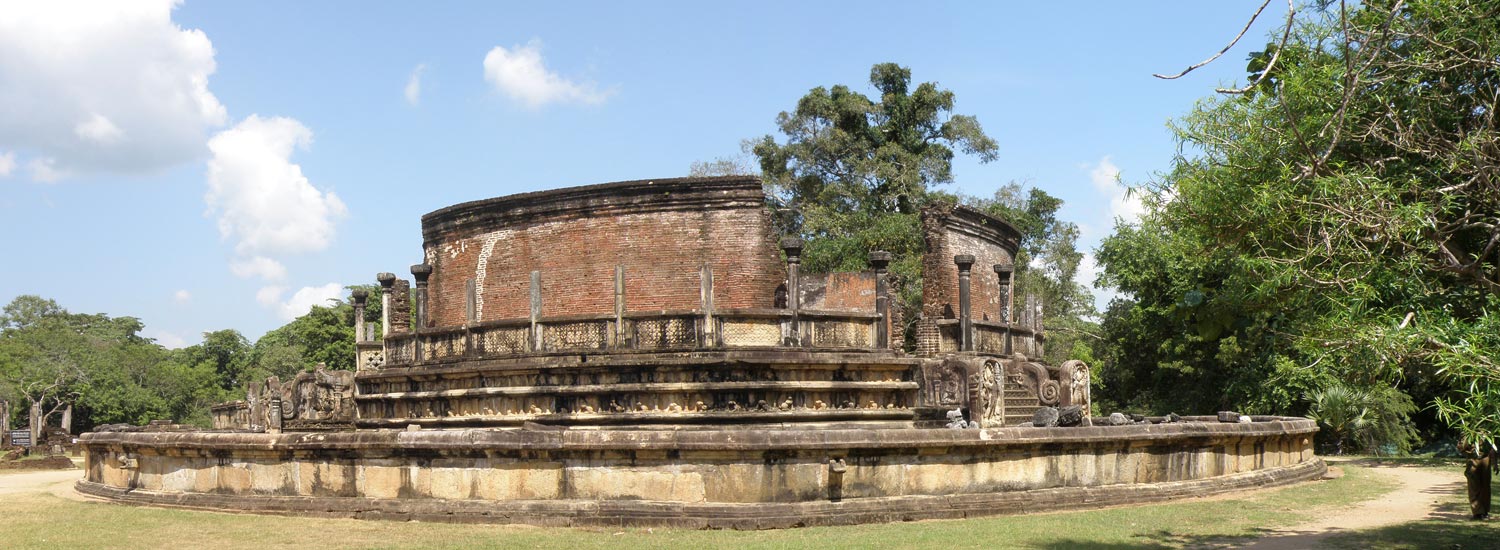
Polonnaruwa is the second most ancient city of Sri Lanka. Located in the North Central Province, it was once the capital of Sri Lanka in the 11th and 12th centuries. This ancient city was first declared the capital by King Vijayabahu I, who defeated Chola invaders in 1070 to reunite the country under a local leader. Polonnaruwa has been declared as the World Heritage Site. Polonnaruwa is known as one of the cleaner and more beautiful cities of the island. This green quaint city is home to some amazing ancient constructions.
Places to See
Royal Palace
This is one never miss attraction, when visiting the Polonnaruwa Heritage City. The palace has been constructed as a seven storey building. It took around seven years and seven months to get completed. Out of the 7 stories having 1000 rooms, only 3 stories with 55 rooms are remaining. The Palace had been destroyed by an invader from south Indian named “Maga’.
Gal Vihara
Gal Vihara is a group of astonishing Buddha images. These images exude the best of Sinhalese rock carving. Consisting of four separate images, interestingly, all the images are cut from one long slab of granite. The standing Buddha image here is 7m tall and is said to be the finest of the series.
Quadrangle
Quadrangle is just a short stroll from the north of the Royal Palace ruins. In architecture, a quadrangle is a space or a courtyard, the sides of which are entirely or mainly occupied by parts of a large building. It is the most concentrated collection of buildings, and consists of all royal palace ruins. It’s the most concentrated collection of buildings one will find in the Ancient Cities an archaeologist’s playpen.
Lankatilaka
Lankatilaka Vihara is one of the most symbolic structures of Polonnaruwa. Although now sadly headless, there is a Buddha statue in the complex standing at a height of 14m. Built by King Parakrabahu the great, the shrine is a definite deviation in terms of Buddhist architecture. The interior walls are decorated with beautiful murals, and the outside walls are divided into five floors.
Rankot Vihara
The largest in Polonanruwa and the fourth largest in Sri Lanka, Rankot Vihara Dagoba is 54m tall. It has been attributed to the reign of King Nissanka Malla, and the construction perfectly imitates the Anuradhapura Style. Like other major Dagobas, the dome has earth fill covered by a brick mantle and plaster.
Dagaba Kiri Vihara
Dagaba Kiri Vihara is a large stupa located north of Lankathilaka Pilima Ge. The term Kiri Vihara means “milk-white”. Created by a queen of the great king Parakramabahu, named “Subadra”, it is the best preserved un-restored dagaba of Polonnaruwa. The original lime plaster is still in perfect condition, even after almost 700 years. The first traditional name of the stupa was “Rupavathi Stupa”.
Trivanka Image House
The literal meaning of Trivanka is “thrice bent”. The name of the structure refers to the fact that the Buddha image inside the complex is in a three-curve position, which is normally reserved for female statues. The building is noted for its fine frescoes depicting Buddha in his past lives.
Best time to visit
The best time to visit Polonnaruwa is between May to October, when the weather is perfect for touring.
How to reach
By Air - The nearest airport to Polonnaruwa is Hingurakgoda Airport, followed by Sigiriya Airport.
By Train - One can get on the train to Trincomalee at Colombo Fort station, connect to Gal Oya, and you are in Polonnaruwa. No train runs to/from Anuradhapura.
By Road - Regular buses to Polonnaruwa leave from Colombo Fort. Direct bus from the Anuradhapura bus station in New Town runs throughout the day and the distance from Anuradhapura to Polonnaruwa is some 100 km. The Polonnaruwa Bus Station is situated 4 km to the east of the main attractions.